
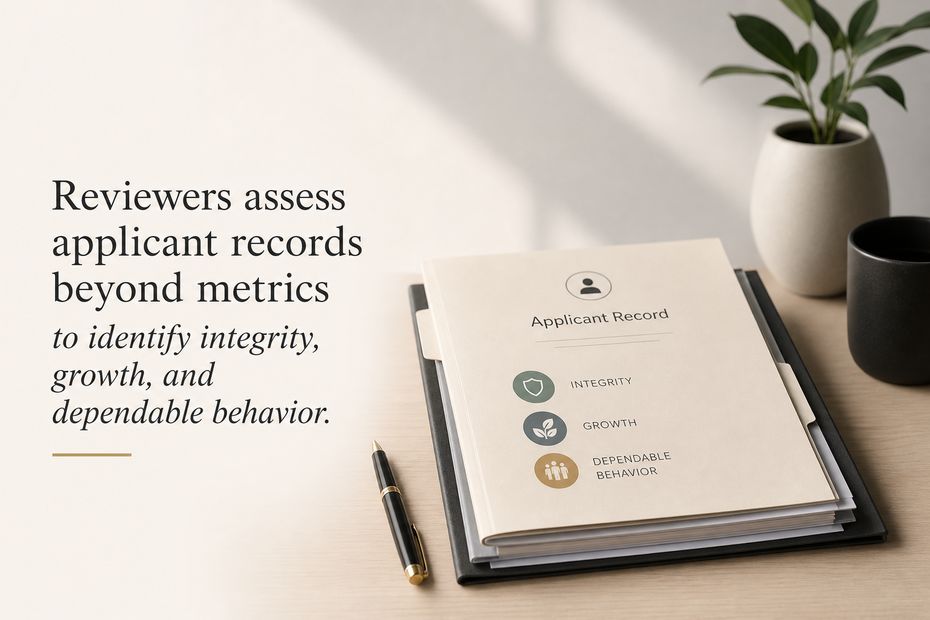
Selection committees identify character over metrics by reviewing evidence of integrity, sustained commitment, accountability, growth, and dependable behavior across an applicant’s full record. Grades and scores still matter, but they cannot show how you respond to setbacks, treat others, or follow through over time.
A fair selection process connects claims about personal qualities to observable behavior in essays, recommendations, activity records, work history, and structured interviews. Understanding how committees interpret that evidence helps you present an authentic application and helps reviewers make consistent, defensible decisions.
Why Do Selection Committees Look Beyond Grades And Scores?
Academic metrics measure certain forms of past performance, but they don’t capture every quality needed for future success. A score cannot establish whether you act honestly, accept responsibility, support a team, or persist when circumstances change.
Numbers remain useful because they give committees a shared reference point. They can indicate academic preparation, technical knowledge, or performance under defined conditions. Their weakness is limited scope: two applicants with similar records may differ greatly in dependability, judgment, motivation, and willingness to learn. Committees need other evidence to distinguish between them.
Whole-file review adds experiences and personal attributes to academic information rather than discarding measurable standards. The Association of American Medical Colleges describes this form of review as an individualized process that balances experiences, attributes, and academic metrics. The goal is to examine what you achieved, the conditions surrounding that achievement, and the behavior you demonstrated along the way. Metrics become one part of the decision rather than the entire decision.
What Does Character Mean In A Selection Process?
Character refers to personal qualities demonstrated through choices and repeated behavior. Committees commonly look for integrity, empathy, accountability, resilience, dependable conduct, ethical judgment, and openness to growth.
These qualities must appear in evidence rather than labels. Writing that you’re resilient carries little weight unless you explain the difficulty you faced, the action you took, and what changed afterward. Calling yourself a leader is also less persuasive than showing how you organized work, resolved disagreement, or accepted responsibility for an unsuccessful result. Specific actions make personal qualities easier to assess.
Committees also distinguish character from charm, confidence, and polish. A persuasive interview does not automatically establish sound judgment, just as a reserved communication style does not indicate weak character. Good reviewers examine how your conduct aligns across multiple sources. They look for repeated patterns instead of rewarding the person who sounds most rehearsed.
Why Do Committees Put Character Over Metrics In Close Decisions?
Committees often place character over metrics when qualified candidates have similar numerical records. At that point, evidence of reliability, ethical conduct, contribution, and sustained effort can separate applicants who appear comparable on paper.
This does not mean that a strong personal story automatically cancels weak preparation. Committees still need evidence that you can meet the academic or professional demands of the opportunity. Personal qualities become especially relevant once candidates meet the required level of readiness. Reviewers then ask which applicant has demonstrated the habits needed to use the opportunity responsibly.
The Harvard Graduate School of Education’s Making Caring Common project encourages colleges to value authenticity, ethical engagement, and meaningful contributions to other people. That guidance also cautions against overvaluing overloaded activity lists and narrow measures of personal achievement. A smaller record of sustained, useful involvement can reveal more than a long collection of brief memberships. Depth gives reviewers clearer evidence of what you value and how you behave.
How Do Committees Measure Consistency In An Application?
Committees measure consistency through duration, depth, follow-through, and growth. They examine whether your commitments continued long enough to produce responsibility, learning, contribution, or a clear pattern of effort.
Long-term involvement can support this assessment, but duration alone is not enough. Remaining in an activity for several years says little if your role, contribution, and engagement never developed. Committees look for increasing responsibility, improved skill, deeper service, or stronger judgment. A consistent record shows movement rather than simple attendance.
Repeated behavior across different settings also carries weight. Dependability may appear through steady employment, regular caregiving, academic recovery, community involvement, or continued contribution to a team. The activity does not need a prestigious title or a large budget. Committees are looking for credible evidence that you honor commitments and adapt when responsibilities change.
Is One Long-Term Activity Better Than Many Short Activities?
One sustained activity often provides stronger evidence than many brief activities, but the quality of involvement matters more than the raw count. Committees consider what you did, why you stayed, how your role developed, and what your participation contributed.
A long-term activity can reveal commitment, patience, skill development, and earned responsibility. It gives reviewers enough time to identify a behavioral pattern. Several shorter activities can also make sense when they share a clear purpose, build related skills, or reflect changing circumstances. A scattered list becomes weaker when the entries appear selected only to fill space or create an image.
Reviewers should avoid assuming that every applicant has equal access to clubs, travel, unpaid service, or formal leadership positions. Paid work, household duties, family care, and practical responsibilities can demonstrate discipline and consistency. The strongest assessment asks what you did with the time, access, and obligations you had. Prestige should not replace substance.
What Evidence Reveals Character And Consistency?
Committees rely on personal statements, recommendation letters, activity histories, academic records, employment information, and relevant background details. No single item proves character, so reviewers compare several sources for agreement, detail, and credibility.
Your personal statement can explain your decisions, values, and response to difficulty. Strong writing focuses on actions and consequences rather than broad claims about being hardworking or compassionate. An honest account may include a mistake, the responsibility you accepted, and the behavioral change that followed. That sequence gives a committee more useful information than a polished story with no tension or self-review.
Recommendation letters can confirm how you behave when no reward is guaranteed. A detailed letter may describe your preparation, treatment of peers, response to criticism, reliability under pressure, or contribution to shared work. Activity and employment records then help reviewers check whether those observations match your broader history. Agreement across independent sources strengthens confidence in the assessment.
Can A Personal Statement Outweigh A Low Grade Point Average?
A personal statement can explain a low Grade Point Average (GPA), but it rarely erases concerns by itself. Its value depends on whether it provides a credible explanation, demonstrates accountability, and matches later evidence of improvement.
Committees usually separate explanation from excuse. A useful explanation identifies the circumstances, states how they affected performance, and shows what you changed within your control. It does not blame other people or ask reviewers to ignore the record. Upward academic performance, stronger work habits, later coursework, or dependable professional conduct can support the statement.
Consistency after a setback matters because it shows whether the improvement lasted. One strong term may indicate progress, but a longer pattern gives reviewers greater confidence. Gaps and interruptions should also be read with care when work, caregiving, health needs, or family hardship affected your available time. Fair review considers the record you produced alongside the responsibilities you were managing.
How Do Structured Interviews Reveal Integrity And Reliability?
Structured interviews assess character by asking every candidate comparable, behavior-based questions. Interviewers then score answers against criteria defined before the interviews begin.
Behavior-based questions ask you to describe what you did in a real situation. You may be asked about a time you made a difficult ethical decision, admitted an error, handled disagreement, met an obligation under pressure, or changed your conduct after feedback. Strong answers identify the situation, your specific responsibility, your action, and the outcome. They also make your individual contribution distinct from the group’s work.
The Society for Human Resource Management recommends structured interviewing practices because a consistent process supports more reliable comparison than an informal conversation. Interviewers can assess whether an answer contains evidence of accountability, honesty, initiative, or dependable conduct. Follow-up questions should test details rather than reward confidence or conversational style. Standardized scoring also limits the influence of first impressions.
How Can Committees Reduce Bias When Assessing Character?
Committees reduce bias by defining character-related criteria in advance, using shared scoring rubrics, assigning multiple reviewers, and requiring evidence for ratings. Reviewers should assess demonstrated behavior rather than vague ideas about likability, similarity, or cultural fit.
Terms such as integrity and resilience need clear behavioral definitions. Integrity could include admitting mistakes, protecting confidential information, giving accurate credit, or making a difficult ethical choice. Resilience could include changing a plan after failure, seeking useful support, or rebuilding performance over time. Defined indicators make scores easier to compare and defend.
Multiple readers can identify differences in interpretation before a decision becomes fixed. Committees can compare ratings, discuss large scoring gaps, and return to the evidence in the file. Training should also address assumptions tied to communication style, school resources, job type, family duties, and access to formal activities. Character assessment becomes fairer when reviewers explain why a behavior meets a stated criterion.
How Should Applicants Demonstrate Character Without Bragging?
You can demonstrate character by describing decisions, actions, and results in precise language. Let the evidence carry the claim instead of repeatedly naming positive traits.
Use verbs that identify your real contribution. Explain what you organized, repaired, learned, measured, changed, or completed. If other people contributed, give them proper credit and separate their work from yours. This balance communicates confidence without exaggeration.
You should also explain gaps or changes directly. A move from one activity to another does not automatically signal inconsistency when the reason is credible and the later record shows commitment. State what changed, how you adjusted, and which responsibilities you continued to meet. Honest explanation is stronger than forcing every experience into a flawless personal narrative.
What Should Committee Members Define Before Reviewing Applications?
Committee members should define the personal qualities relevant to the opportunity, the evidence that can demonstrate those qualities, and the scoring rules reviewers will use. These decisions should occur before individual applicants influence expectations.
Criteria must connect to actual program or role demands. A scholarship committee may emphasize service, accountability, and sustained contribution. A hiring committee may focus on reliability, ethical judgment, teamwork, and response to feedback. Reviewers should avoid adding attractive but unrelated qualities after meeting a memorable candidate.
Committees should also decide how metrics and personal evidence interact. Minimum preparation requirements may remain necessary, but cutoffs should not be treated as proof of character or future conduct. Reviewers need a process for documenting reasons, resolving disagreements, and examining unusual records fairly. Transparent criteria improve consistency for committee members and applicants.
How Do Selection Committees Assess Character And Consistency?
- Review essays, recommendations, records, and circumstances.
- Look for sustained commitment, growth, and ethical behavior.
- Use structured, behavior-based interviews.
- Treat metrics as evidence, not the entire decision.
Make The Record Show Who You Are
Strong selection decisions come from connecting claims about character to repeated, observable conduct. If you’re applying, show what you did, how long you followed through, how you handled difficulty, and what changed through the experience. If you’re reviewing candidates, define personal qualities before reading files and score evidence rather than polish or familiarity. Choosing character over metrics does not require ignoring performance data; it requires interpreting that data alongside integrity, accountability, growth, and consistent action. The strongest record is one in which the numbers and the behavior tell a credible, connected story.
References
- Association of American Medical Colleges: Applicant Review Guidance
- Harvard Graduate School of Education, Making Caring Common: Turning the Tide
- National Association for College Admission Counseling
- Society for Human Resource Management: Conducting Structured Interviews
- VIA Institute on Character: Character Strengths
- Harvard Business Review: Hiring
- American Psychological Association: Psychology in the Workplace.