
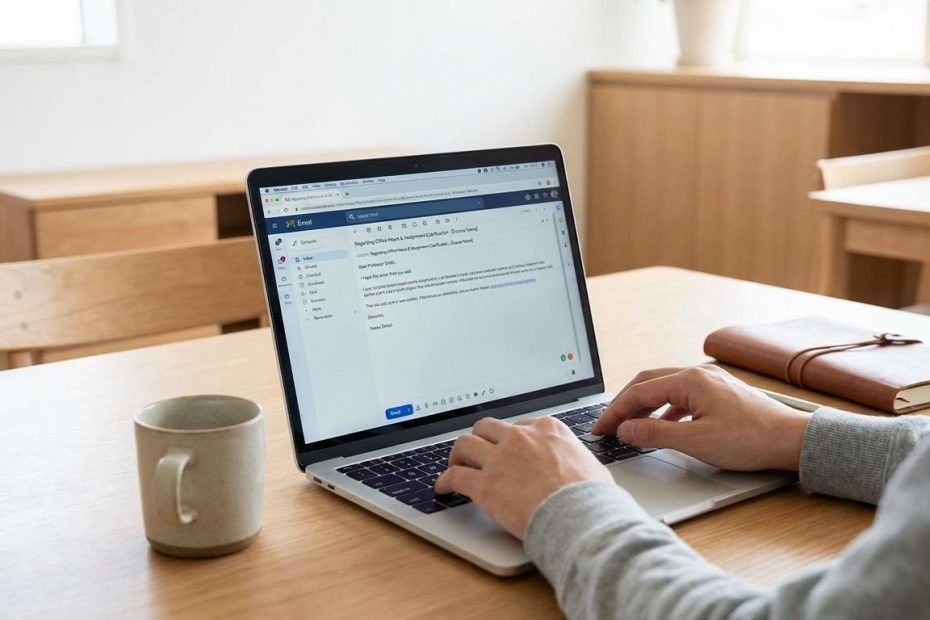
You email a professor effectively by being brief, specific, respectful, and easy to help. The strongest messages identify your course, state the exact issue, and make one clear request the professor can answer fast.
Emailing a professor does not need to feel tense or formal in a stiff way. When you understand what instructors actually need from your message, you can ask for office hours, request an extension, or get assignment clarification without sounding awkward, vague, or demanding.
This guide shows you how to write emails that get read, understood, and answered. You will learn what to include, what to avoid, when to follow up, and how to use proven templates that fit real academic situations.
How Do You Email A Professor For Help Without Sounding Awkward?
The fastest way to sound confident is to stop aiming for “perfect” and start aiming for “clear.” Professors read a large volume of messages, and the emails that work best are usually the ones that state the purpose early, identify the course, and avoid unnecessary buildup.
You do not need dramatic politeness, long apologies, or a complicated explanation of why writing the email felt difficult. A professional greeting, one sentence that explains who you are, and one sentence that states what you need will do far more than an overly careful message that circles around the request.
Students often assume awkwardness comes from asking for help at all. In practice, awkwardness usually comes from vagueness. If your message says only “I need help” or “Can you explain the assignment,” your professor has to do the work of figuring out what kind of help you need, which class you are in, and how urgent the issue is.
You sound more prepared when you identify the course name, mention the assignment or topic, and ask a focused question. That signals respect for your professor’s time and shows that you are managing the communication like a serious student rather than sending a last-minute note with missing details.
Subject lines matter more than many students realize. A blank subject line, “Hi,” or “Question” forces the professor to open the message before understanding the topic. A stronger subject line works like a label: “BIO 110 Question About Lab Report Format” or “ENG 204 Request To Discuss Thesis Draft.”
The greeting should match the level of formality used in academic communication. Use “Dear Professor Last Name” or “Dear Dr. Last Name” unless the professor has told the class to use a different form of address. Starting too casually can make the message feel careless, and overdoing the greeting can make it sound unnatural.
The body of the email should move in a straight line. Identify yourself, state the issue, ask the question, and close politely. That structure works across almost every situation because it reduces back-and-forth and helps your professor answer in one response.
Use this template when you need general help:
Subject: POLS 101 Question About Discussion Post
Dear Professor Ahmed,
I am Taylor Brooks from your POLS 101 Monday and Wednesday class. I am writing because I need clarification on the discussion post requirements for this week. Should the response include citations from the textbook, or should it focus only on the lecture material?
Thank you for your time.
Taylor Brooks
That email works because it is easy to scan and easy to answer. Your professor does not have to guess who sent it, what class it concerns, or what kind of response will solve the problem.
How Do You Ask A Professor To Meet During Office Hours Or Outside Office Hours?
Office hours exist for exactly this reason: questions, clarification, review, and academic support. Many students treat office hours like a last resort, yet professors often see them as the most efficient way to handle issues that would otherwise turn into a long email chain.
If your professor lists office hours in the syllabus or course site, you often do not need to send a formal request unless the instructions say “by appointment.” When office hours are open drop-in times, the most effective move is to show up prepared with your question, notes, draft, or problem set.
If you cannot attend the posted time, send an email that explains the conflict and offers specific alternatives. Avoid asking, “Can we meet sometime?” That puts the scheduling burden on the professor and slows the process. Instead, give two or three realistic options that fit your schedule.
Professors respond better when the request shows purpose. “I would like to meet to review my thesis statement before the paper is due” is stronger than “I wanted to talk about class.” Specificity helps your professor decide how much time is needed and whether the issue is better handled in person, over video, or by a short email reply.
Preparation matters once the meeting is set. If you ask for office hours help with an assignment, review the prompt first. If you need help with a problem set, mark the exact questions causing trouble. If you want feedback on a draft, bring the current version and identify the part you want the professor to address.
Many instructors become frustrated when a student asks for urgent help but has not reviewed the course materials first. A meeting request becomes stronger when you show that you have already read the syllabus, looked at the assignment instructions, or attempted the work yourself.
Use this template when attending outside the posted time is necessary:
Subject: CHEM 101 Request To Meet Outside Office Hours
Dear Professor Patel,
I am Jordan Ruiz from your CHEM 101 section. I have a scheduling conflict during your posted office hours on Wednesday, and I would like to meet to review stoichiometry before the quiz. Would you be available on Thursday after 2:00 p.m. or Friday between 10:00 a.m. and noon?
Thank you,
Jordan Ruiz
You can also use a shorter version if the professor already knows you well:
Subject: HIST 210 Office Hours Question
Dear Professor Lee,
I would like to stop by office hours to ask about my source analysis, but I have a conflict during your regular time. If possible, could we meet briefly on Tuesday afternoon or Wednesday morning?
Best,
Maya Chen
When the meeting is confirmed, reply and acknowledge it. A quick confirmation keeps the communication clean and shows professionalism. If you cannot make the meeting after all, send notice early rather than disappearing.
How Do You Email A Professor For Clarification On An Assignment Or Deadline?
Clarification emails work best when they narrow the issue instead of reopening the entire assignment. Professors are far more likely to respond quickly when your message identifies the exact requirement, page, reading, format rule, due date question, or grading expectation that needs explanation.
Start by checking the syllabus, assignment sheet, course announcements, and learning management system. If the answer is already posted in those places, sending an email that ignores them can make your message look rushed. A better move is to mention that you reviewed the instructions but still need clarification on one point.
That small detail changes the tone of the email. It shows initiative. It tells your professor you did not outsource the basic reading. It also frames the question in a way that makes it easier to answer without frustration.
A common mistake is packing several unrelated questions into one paragraph. If you genuinely need answers to more than one point, keep the questions tightly connected and list them in a clean way. That makes the email easier to skim and reduces the chance that one of the questions gets missed.
Another frequent problem is asking for clarification too late. If an assignment is due soon, a professor may not be available to respond immediately, especially outside business hours. Asking earlier gives you more time to adjust and makes the request sound responsible rather than urgent because of delay.
Use wording that shows exactly where confusion begins. “I reviewed the assignment sheet, but I am unsure whether outside sources are required in the analysis portion” is much stronger than “I do not understand the assignment.” The first version invites a direct answer. The second version requires the professor to diagnose the whole problem.
Use this template when you need clarification on instructions:
Subject: PSY 230 Clarification On Case Study Requirements
Dear Dr. Nguyen,
I reviewed the assignment sheet and syllabus, but I am still unclear about one requirement for the case study. Should the analysis include outside scholarly sources, or should it rely only on the course readings?
Thank you for your help.
Elena Garcia
Use this variation when the question involves a deadline or submission rule:
Subject: SOC 202 Question About Reflection Paper Submission
Dear Professor Martin,
I checked the syllabus and course site, and I want to confirm the submission details for the reflection paper. Is the paper due at the start of class, or should it be uploaded to the course portal by the deadline listed there?
Thank you,
Noah Bennett
If classmates are giving conflicting answers, do not mention rumor as your source of confusion in a dramatic way. Keep the message grounded in the written materials and the exact point you need confirmed. Your professor is much more likely to answer a precise question than a message built around class chatter.
When a clarification issue is bigger than one sentence can solve, move the conversation toward office hours. You can say that you would appreciate a brief meeting if the issue is easier to explain there. That gives your professor flexibility and often speeds up resolution.
How Do You Ask A Professor For An Extension By Email?
An extension request stands or falls on timing, clarity, and credibility. If you need more time, send the email as early as possible, identify the assignment, ask directly, and propose a realistic new deadline. Professors are much more receptive when the message gives them enough information to make a decision without multiple follow-ups.
Do not bury the request under a long story. Professors do not need a dramatic narrative to understand the situation. They need the course name, the assignment name, the current due date, the reason in brief, and the specific extension you are requesting.
Another mistake is leaving the new date open-ended. “Can I have more time?” forces the professor to define the terms for you. “Could I have a 48-hour extension and submit by Thursday at 5:00 p.m.?” is stronger because it presents a concrete, manageable request.
You also need to accept that the answer may be no. Some professors follow a strict late policy. Others allow flexibility but only under certain conditions. Your email should respect that reality by asking directly without sounding entitled.
It helps to acknowledge the course policy if you know it. If the syllabus addresses late work, mention that you reviewed it and still want to ask whether an exception is possible. That small move shows respect for the rules and puts the request in a professional frame.
Keep the reason concise. “Unexpected illness,” “family emergency,” or “overlapping academic deadlines affecting completion” is enough in many cases. You do not need to overexplain unless the professor or institution requires documentation.
Use this template when you need an extension before the deadline:
Subject: ECON 201 Request For Extension On Problem Set 4
Dear Professor Harris,
I am Alex Morgan from ECON 201. I am writing to ask whether you would allow a 48-hour extension on Problem Set 4, currently due Wednesday, because of an unexpected personal emergency this week. If approved, I will submit it by Friday at 5:00 p.m. I understand if course policy does not allow this, but I wanted to ask before the deadline.
Thank you for considering my request.
Alex Morgan
Use this variation when the course already has a stated late policy:
Subject: ENG 204 Request Regarding Draft Deadline
Dear Professor Collins,
I reviewed the late work policy in the syllabus, and I understand that extensions are limited. I am requesting a short extension on the draft due tonight because I have been managing an unexpected medical issue. If possible, I would submit the paper tomorrow by 3:00 p.m.
Thank you for your consideration.
Sofia Ramirez
If the deadline has already passed, the email becomes harder to approve, but it still needs to be direct. Acknowledge that the assignment is late, take responsibility, and ask whether submission is still possible under the course policy. Do not write as if the extension is already assumed.
That kind of message might look like this:
Subject: BIO 150 Late Submission Request For Lab Summary
Dear Professor Kim,
I am writing regarding the lab summary that was due yesterday. I was unable to submit it on time, and I take responsibility for missing the deadline. If submission is still possible under your policy, I would like to turn it in by tomorrow evening and accept any applicable late penalty.
Thank you for your time.
Priya Shah
The strongest extension requests are calm, specific, and early. The weakest ones are vague, emotional, or sent after the deadline without any ownership of the situation. If you need the professor to say yes, make the request easy to evaluate and easy to grant.
What Should You Include In An Email So A Professor Can Help You Quickly?
If you want a useful reply, include the information that lets your professor act immediately. That means your full name, course name or number, section if relevant, the exact issue, and the action you want from the professor.
This sounds simple, yet many student emails leave out one or more of those details. A professor teaching multiple sections may not know which class you are in. A generic question without the assignment name may require a follow-up. A meeting request with no schedule options forces another email exchange before anything is resolved.
A strong academic email reduces friction. It gives the professor everything needed to answer the question, approve the request, or direct you to the right next step. That is the standard you want to meet every time.
Start with a clear subject line. Then open with your course identification. After that, state the issue in one or two sentences and end with a specific request. That structure works whether you are asking for office hours, feedback, deadline clarification, or help after receiving a grade.
It also helps to include what you have already checked or done. Mentioning that you reviewed the syllabus, read the assignment sheet, attempted the problem, or visited the course portal signals preparation. Professors notice that difference immediately.
These are the core elements your email should include:
- Your full name
- Your course name, course number, and section if needed
- A direct subject line
- The exact assignment, topic, or issue
- A clear question or request
- Relevant timing, meeting options, or proposed new deadline
- A polite closing and your name
You can also improve response quality by trimming anything that does not help the professor answer. Long explanations, repeated apologies, and vague emotional language usually weaken the message. Efficient writing does not sound cold in academic communication. It sounds organized.
Here is a strong general-purpose structure you can adapt:
Subject: MATH 118 Question About Quiz Corrections
Dear Professor Rivera,
I am Samir Ali from MATH 118 Section 03. I am writing to ask whether quiz corrections are allowed for last week’s assessment, and if so, whether there is a submission deadline. I reviewed the course page but did not see instructions for that process.
Thank you,
Samir Ali
That message includes identity, course context, the exact request, and evidence that the student checked the course materials first. It saves time for everyone involved.
If your email includes an attachment, mention it directly in the body. If you are asking about a draft, say what kind of feedback you want. If you are requesting a meeting, give time windows. When you reduce ambiguity, you increase the chance of a fast and helpful reply.
What If Your Professor Does Not Reply To Your Email?
A missing reply does not automatically mean your professor is ignoring you. Instructors manage teaching, grading, advising, meetings, and administrative work, and email volume can get crowded fast. A message can be missed, buried, or delayed without any personal meaning.
Your response should stay measured. Wait a reasonable amount of time, then send one polite follow-up that references the original message. Do not send repeated emails within a few hours unless the professor has explicitly invited urgent contact that way.
The follow-up should be short. Restate the issue in one sentence, mention the earlier email, and offer an alternate path if helpful, such as stopping by office hours. Keep the tone professional and neutral. The goal is to make the follow-up useful, not to signal frustration.
Use this template when you need to follow up:
Subject: Follow-Up: BIO 110 Question About Lab Report Format
Dear Professor Kim,
I wanted to follow up on my earlier email about the BIO 110 lab report format. I know your schedule may be full, but I would appreciate any clarification when you have a moment. I can also stop by office hours this week if that is easier.
Best,
Priya Shah
If the issue is urgent and your professor holds office hours before the deadline, attending those office hours is often the smartest move. That route can solve the problem faster than waiting on email, especially when the question involves a paper draft, exam review, or assignment instructions that need a conversation rather than a one-line answer.
You should also check whether the course has a preferred communication channel. Some professors use the learning management system messaging tool, discussion boards, or teaching assistants for routine questions. If that expectation appears in the syllabus, follow it.
If there is still no response after a polite follow-up and the matter affects grading, access, or a time-sensitive class requirement, keep the next step proportionate. Attend office hours, use the official course platform, or contact the teaching assistant if one exists. Escalation beyond that should be reserved for genuine academic or administrative necessity, not ordinary delay.
One thing to avoid is emotional escalation in writing. “I emailed twice and still have no answer” may feel justified, but wording like that can turn a simple delay into a tense exchange. Stay focused on the unresolved issue and the practical next step.
You also improve your odds of getting a reply by sending stronger emails in the first place. Messages with a clear subject line, complete course information, and one direct request are easier to answer and less likely to sit untouched in a crowded inbox.
What Common Email Mistakes Make Professors Less Likely To Respond Well?
Most professor email mistakes are not rude in an obvious way. They are inefficient. They force the reader to guess, decode, or ask for missing details before any real help can happen.
The most common mistake is sending a vague message. “Can you help me?” sounds polite, but it does not give the professor enough information to act. The same problem appears in emails that mention “the assignment” without naming it, or “class” without identifying the section.
Another major mistake is asking questions already answered in the syllabus, course announcements, or assignment sheet without showing that you reviewed them. Professors tend to respond better when your email says you checked the written instructions and still need clarification on a specific point.
Timing also matters. Last-minute emails sent late at night before an exam, quiz, or deadline create pressure the professor may not be able to resolve. If you wait until the final hours, your message becomes harder to answer usefully, even if the question itself is reasonable.
Overly casual tone can also weaken the message. Starting with “hey,” leaving out a greeting, using text-style shorthand, or omitting your name gives the email an unpolished feel. Academic email does not need to sound stiff, but it does need to sound intentional.
Another issue is writing long paragraphs that hide the actual request. Professors should not have to search through a full screen of explanation to find the one question you need answered. Put the purpose near the top, then add only the supporting detail that matters.
These mistakes are worth avoiding:
- Using a blank or vague subject line
- Leaving out your course and section
- Asking broad questions with no specific issue
- Ignoring instructions already posted in the syllabus
- Sending an extension request after the deadline without acknowledging it
- Using casual or text-message style language
- Sending multiple urgent follow-ups too fast
- Asking for a meeting without offering times or purpose
Strong emails are respectful because they are usable. That is the standard to keep in mind. If your professor can understand the issue and respond in one pass, your email is already doing its job.
How Do You Make Your Email More Likely To Get A Helpful Response?
If the goal is not just a reply but a useful reply, the email has to make action easy. That means writing with the professor’s workflow in mind. Professors move fast through inboxes, and messages that are scannable, specific, and complete usually get better outcomes.
Lead with the purpose. Put the request in the first few lines rather than saving it for the end. That helps the professor prioritize the message and decide whether the answer can be given immediately or would work better through office hours.
Use a message length that fits the issue. A clarification question may need only three or four lines. A meeting request may need your availability. An extension request may need a little more detail. The right email is not the shortest one possible, but the shortest one that includes all necessary facts.
Tone matters, but not in the way many students think. You do not need elaborate courtesy to sound respectful. Respect comes through in precision, preparation, and reasonable expectations. A professor is more likely to respond well to a direct, well-structured email than to a very apologetic message that still leaves out the point.
It also helps to send the email through your school account if your institution uses one. That can reduce confusion, help the professor identify you faster, and signal that the message is part of normal academic communication.
Before sending, run a quick quality check:
- Does the subject line identify the topic?
- Did you include your full name and course?
- Did you ask one clear question or make one clear request?
- Did you remove extra detail that does not help the professor answer?
- Did you check spelling of the professor’s name and title?
- Did you review the syllabus or assignment instructions first?
That quick review takes less than a minute and can change how your message is received. Emailing professors is not about sounding impressive. It is about making academic communication smooth, professional, and easy to act on.
Quick Answer Templates You Can Adapt Fast
Sometimes you do not need more advice. You need language you can use right away. These short templates cover the most common academic email situations and keep the request clear.
General Help Template
Subject: Course Question About [Topic]
Dear Professor [Last Name],
I am [Full Name] from your [Course Name and Section]. I am writing because I need help with [specific topic or assignment]. My question is: [clear question].
Thank you,
[Your Name]
Office Hours Template
Subject: Request To Meet About [Topic]
Dear Professor [Last Name],
I would like to meet to discuss [specific issue]. I am unavailable during your posted office hours because of [brief reason]. Would you be available at [time option], [time option], or [time option]?
Best,
[Your Name]
Clarification Template
Subject: Clarification On [Assignment Name]
Dear Professor [Last Name],
I reviewed the assignment instructions and syllabus, but I am still unclear about one point. Should [specific requirement question]?
Thank you for your help.
[Your Name]
Extension Request Template
Subject: Request For Extension On [Assignment Name]
Dear Professor [Last Name],
I am writing to ask whether you would allow a short extension on [assignment name], due [current deadline], because of [brief reason]. If approved, I will submit it by [specific new deadline]. I understand if course policy does not allow this.
Thank you for considering my request.
[Your Name]
Follow-Up Template
Subject: Follow-Up: [Original Topic]
Dear Professor [Last Name],
I wanted to follow up on my earlier email regarding [topic]. I would appreciate any guidance when you have a moment. I can also come to office hours if that is easier.
Best,
[Your Name]
Templates save time, but they work only if you personalize them. Replace placeholders, name the course accurately, and state the exact issue. The difference between a generic email and an effective one is usually one sentence of specificity.
Best Way To Email A Professor For Help
- Use a clear subject line
- State your name, course, and issue early
- Ask one direct question or request
- Keep the email brief and professional
- Offer times or a deadline if relevant
Write The Email That Gets Answered
When you email a professor, your goal is not to sound perfect. Your goal is to make the message easy to read, easy to answer, and easy to act on. If you identify yourself, name the course, explain the exact issue, and ask directly for what you need, you remove most of the friction that causes weak academic emails to fail. That matters whether you need office hours, assignment clarification, an extension, or a follow-up after no response. Build the habit now, and you will communicate more effectively not just in college, but in every professional setting that expects concise, respectful writing.
References
- https://www.niu.edu/student-life/on-track/prof-email.shtml
- https://www.stlawu.edu/offices/academic-support/strategies-academic-success/communicating-faculty
- https://www.umb.edu/writingcenter/services-for-students/undergraduate-writing-resources/emailing-your-professor/
- https://learningcenters.rutgers.edu/resources/maximize-office-hours
- https://advising.stanford.edu/current-students/advising-student-handbook/email-faculty
- https://www.reddit.com/r/college/comments/xd5rs3
- https://www.reddit.com/r/Professors/comments/1gobgco
- https://www.reddit.com/r/Professors/comments/11kst92
- https://www.reddit.com/r/Professors/comments/1qze9ui
- https://www.reddit.com/r/universityofauckland/comments/1rzjszh/emailing_your_lecturer/
- https://www.reddit.com/r/Professors/comments/1s3xemy/have_you_ever_refused_a_request_for_a_deadline/.